
Standard version module
The standard version module summarizes 16 entrances, functions and usage scenarios of Zhichao AI.
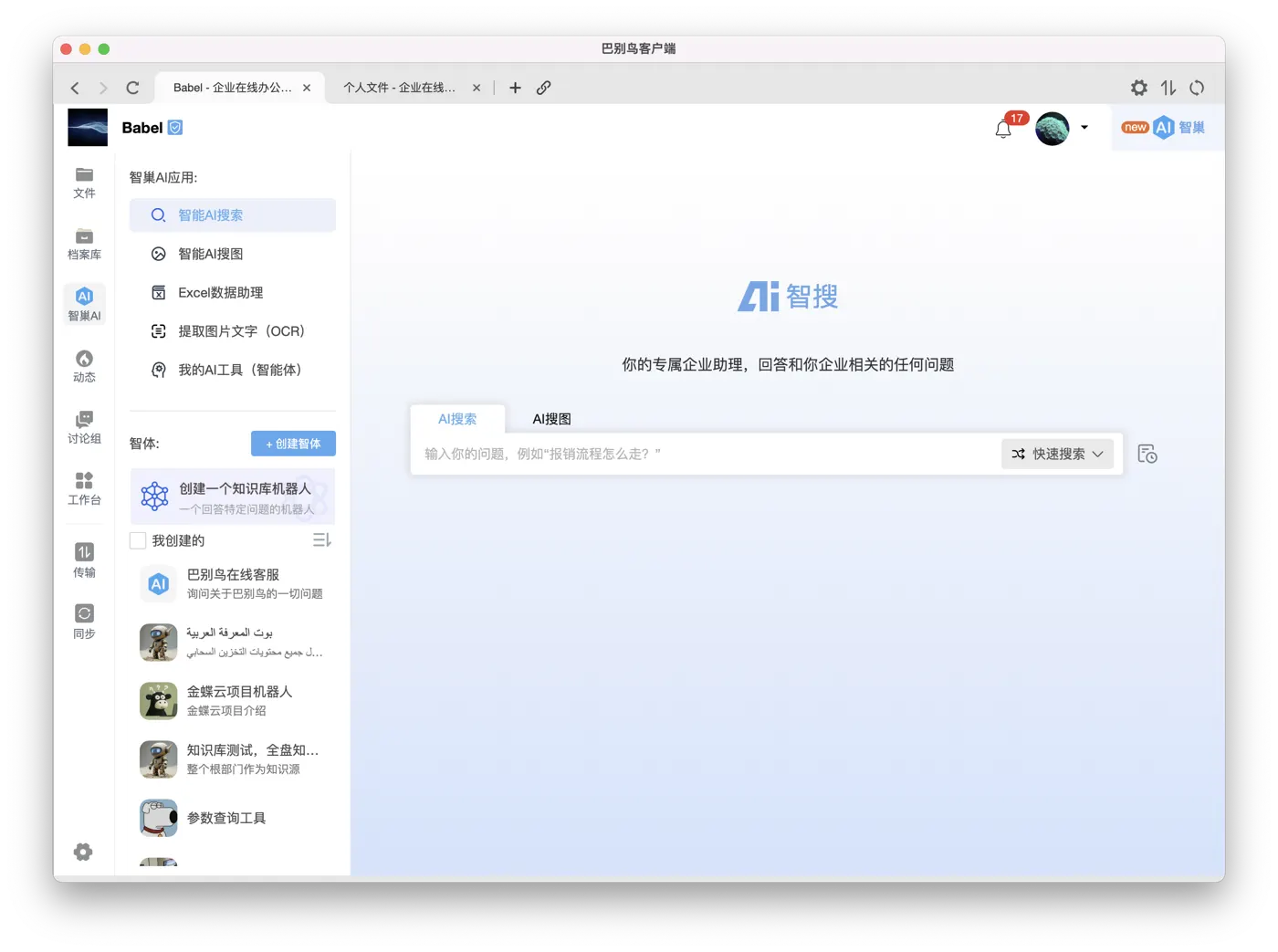
Standard version module list
The following modules constitute the main functional scope of Zhichao AI Standard Edition. Actual entry and availability may be affected by version, entitlement, and deployment configuration.
| Number | Module | Entry | Function |
|---|---|---|---|
| 1 | Zhichao AI Assistant | Top right AI assistant entrance | Conduct AI conversations based on the enterprise knowledge base, and answer questions in combination with online searches |
| 2 | AI search | Search bar | The search results include AI search content and use natural language to find corporate information |
| 3 | Zhisou | Zhichao AI column | Provides question answering, in-depth research and article writing capabilities |
| 4 | Wensoitu | Zhichao AI Column | Search for pictures in the network disk through text description |
| 5 | Image search | Zhichao AI column, image thumbnail entrance | Match similar images in the network disk by uploading or selecting images |
| 6 | Image OCR | Search, Zhichao AI column | Recognize the text in the image and let the image content participate in the search |
| 7 | Document Assistant | File Preview Interface | Summary, Q&A and reading assistance based on the current document |
| 8 | AI automatic tagging | File list | Match the closest tag in the tag library for the selected document |
| 9 | Table Q&A | Excel file preview interface, Zhichao AI column | Q&A, table generation and function operations based on Excel |
| 10 | Deep thinking | AI assistant, form question and answer, document assistant | Switch to a deeper reasoning mode for complex problems |
| 11 | Internet search | AI assistant | Search Internet content and answer with external knowledge |
| 12 | In-depth research | Intelligent search in the Zhichao AI column | Research-based answers are formed through multiple rounds of search and comprehensive sorting |
| 13 | Enterprise knowledge base | Backend server | Enterprise documents are automatically stored in the database to form a questionable and searchable knowledge base |
| 14 | Knowledge base robot | Zhichao AI column "Create an agent" | Create a customizable agent or knowledge base robot |
| 15 | PDF image search | Search bar | Search image content in PDF documents with images |
| 16 | MCP interface | Interface | Provides knowledge base access and network disk file operation capabilities to OpenClaw and other AI applications |
Module relationship
These 16 modules can be divided into four groups: the first group is dialogue, search, document reading and form question and answer for ordinary users; the second group is multi-modal retrieval for images, PDF images and OCR; the third group is enterprise knowledge base, knowledge base robots and agent configuration for administrators and implementation teams; the fourth group is MCP interfaces, third-party data sources and on-demand development capabilities for development and integration.
Implementation suggestions
- First, confirm whether the company needs to solve most problems: "finding files", "reading documents", "doing customer service", "analyzing forms" or "external knowledge base".
- AI assistant, AI search, document assistant and form Q&A are given priority to internal employees.
- Focus on enabling text search, image search, image OCR and PDF image search for material or brand teams.
- Focus on configuring knowledge base robots and custom agents for customer service, pre-sales, training and institutional Q&A scenarios.
- For scenarios that require external AI applications to access the knowledge base or perform file operations, plan MCP interface permissions and audit policies.
Permissions and usage boundaries
- Zhichao AI’s answers, searches, and file references should follow Babel’s existing permission system. Users can only access content within their account, department, project, share, and file access controls.
- Materials used for learning, training, indexing, or Q&A should be specified by the enterprise or administrator; all files should not be considered public knowledge sources by default.
- External customer service, website embedding, third-party data sources, privatized models and GPU computing power are optional deployment or customization capabilities and should be subject to actual authorization, implementation plan and enterprise configuration.
- When AI answers involve high-risk content such as contracts, finance, medical, legal, and engineering safety, the AI output should be used as auxiliary information and reviewed by professionals.
Related information
- Permission system
- Security and Audit
- FAQ: Deployment, AI and technical issues
- Public introduction: <https://zhuanlan.zhihu.com/p/2052372550513072059>