
AISearch
AI search is used to retrieve corporate documents, materials and knowledge within scope of authority using natural language.
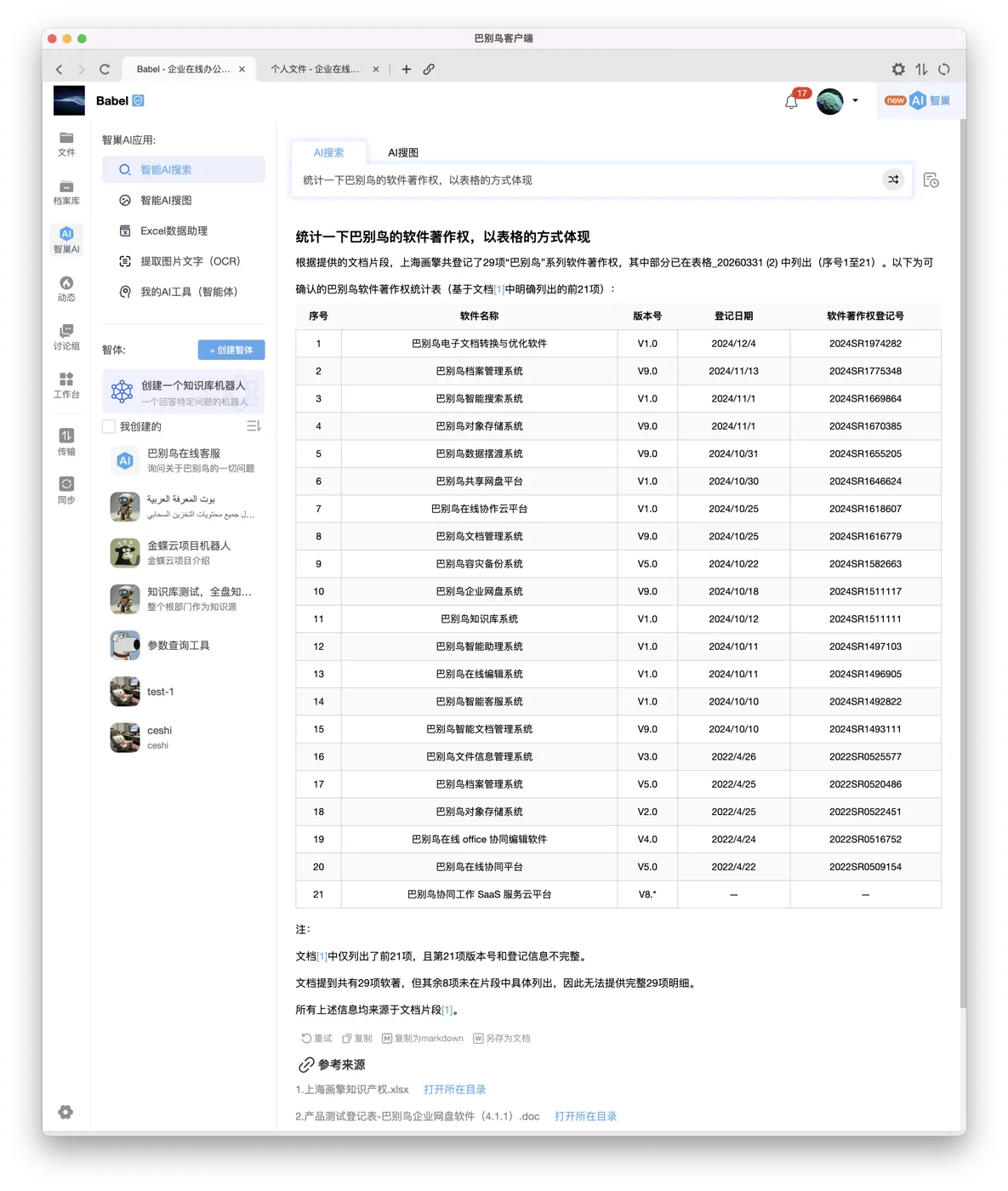
Function description
AI search is oriented to enterprise information question and answer and knowledge retrieval. Users can input natural language questions, and the system will retrieve relevant documents within the scope of authority and combine them with large models to generate answers. It is suitable for answering questions such as "How is a certain system stipulated?" "Where are the design materials for a certain project?" "What are the key terms in a certain customer contract?" "What are similar contents in certain types of documents?"
Main abilities
- Study documents, knowledge materials and file contents within the designated scope of the enterprise.
- Determine the retrieval range based on user permissions to avoid unauthorized responses.
- Supports follow-up questions, users can continue to delve deeper into the last answer.
- The answer gives the source of the information, making it easier for the user to return to the corresponding file for verification.
- Supports recognition of text in pictures and can be combined with OCR and multi-modal capabilities.
- Search results can include AI-generated content, or go back to the original file to verify the source.
- Complementary with full-text search, tag, description, annotation, file name search and other capabilities.
Applicable scenarios
- Questions and answers about corporate systems, processes, contracts, project materials, product descriptions and customer service materials.
- Data retrieval for R&D, engineering, design, legal, administrative, human resources and other departments.
- Quick location of multi-file, multi-project, and multi-version data.
- Allow new employees to ask questions to understand the company's information, rather than rummaging through directory after directory.
Permissions and usage boundaries
- Zhichao AI’s answers, searches, and file references should follow Babel’s existing permission system. Users can only access content within their account, department, project, share, and file access controls.
- Materials used for learning, training, indexing, or Q&A should be specified by the enterprise or administrator; all files should not be considered public knowledge sources by default.
- External customer service, website embedding, third-party data sources, privatized models and GPU computing power are optional deployment or customization capabilities and should be subject to actual authorization, implementation plan and enterprise configuration.
- When AI answers involve high-risk content such as contracts, finance, medical, legal, and engineering safety, the AI output should be used as auxiliary information and reviewed by professionals.
Related information
- Permission system
- Security and Audit
- FAQ: Deployment, AI and technical issues
- Public introduction: <https://zhuanlan.zhihu.com/p/2052372550513072059>